
23102 NE 3rd Avenue, Ridgefield, WA 98642
Voice (360) 887-0702 Fax (360) 887-1930
Email TowMeUp@iesonline.cc
Tree - Self Rescue Kit Information and Sales Page |
|
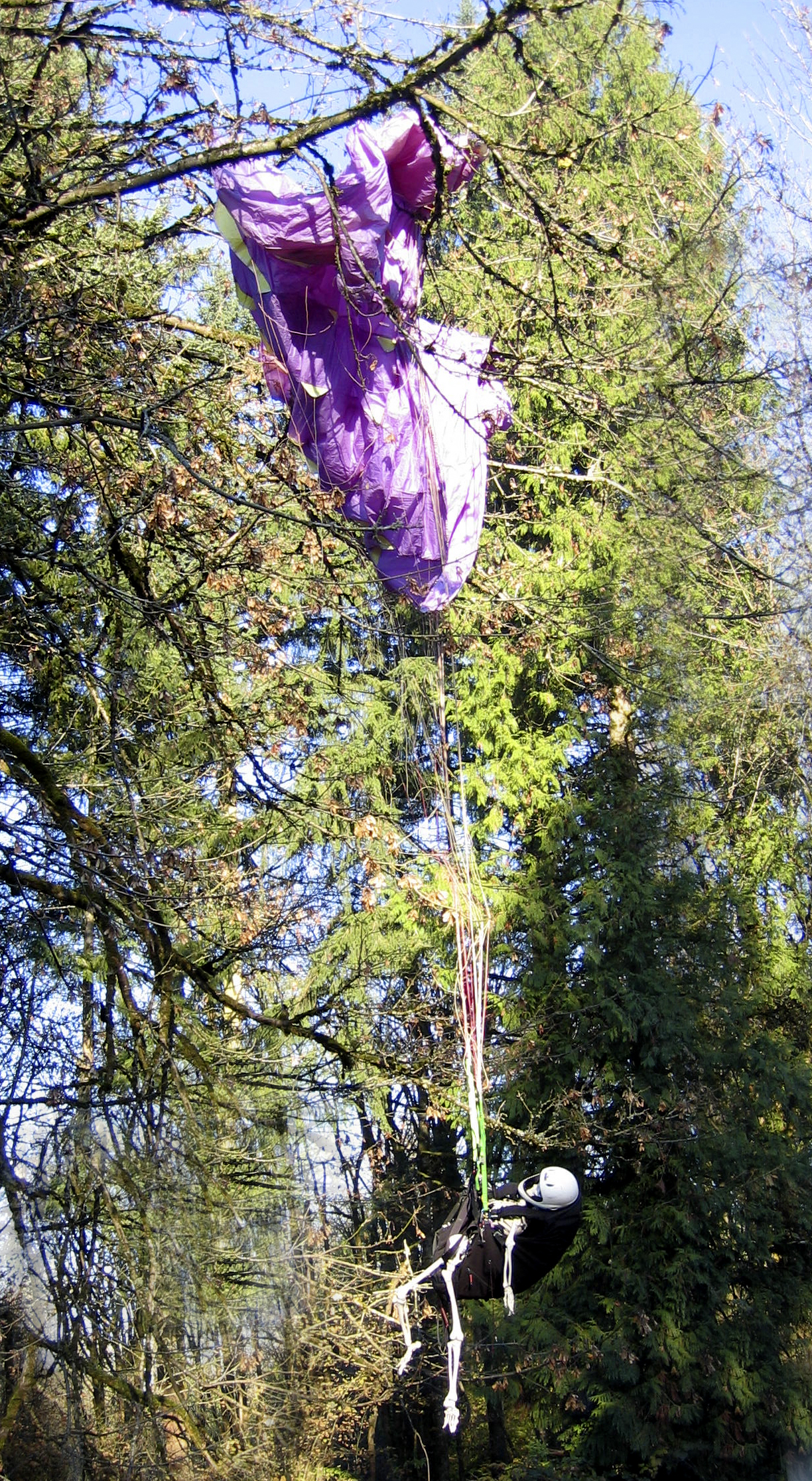 |
Don't Be Left Hanging Around!Sometimes we make mistakes. We forget that we are first and foremost glider pilots and that if the lift ends, we need to have a place that we can still glide to and maneuver to make a safe landing. Sometimes the wind picks up unexpectedly and what was an easy glide out to our landing zone is now impossible and we are forced to assess other options. Perhaps an equipment malfunction like the tangled brake line in the upper cascades of this poor fellows glider degraded the performance so that what is normally an easy glide to the LZ is now impossible. Maybe you had to throw your reserve in the heat of battle, and you were lowered into the forest canopy because of your limited control. One thing is certain. As long as there are pilots flying paragliders, pilots will be landing(?) in trees. Typically a tree landing causes little or no damage to the pilots or their gear. It is a proven fact that it is often far safer to maneuver to land under control in a tree canopy than to suffer the results of radical maneuvering in an attempt to force an arrival into a landing zone that is too small, or to try to extend the glide to a point that can't be reached. Once you're in the tree though, what do you do? The first thing should be to secure yourself and stay put while you assess your options. Are you secure, or likely to fall out of the tree because you are barely caught? If you're secure, you should first get on your radio or cell phone and let others know where your are, and what's going on. If it looks like the ride isn't over yet, and your about to fall out of the tree, you might consider pulling on your reserve handle to get your kit, and tossing the works over any branches close enough to reach... just in case. If you have no radio, no friends, and no way down, you may end up looking like our model. This is where our Tree-Self Rescue kit comes in. It's designed to allow you to safely extract yourself from the tree. Whether you choose to rescue your gear, or leave it for later retrieval depends on your skills and each individual situation. Note - The image depicted to the left, while a distinct possibility, is not real. It was staged using some gear normally lying around our shop at one of our clinics. No pilots were sacrificed, starved, weather beaten, or otherwise injured in the shooting of these photos. |
As I sat down to review this page, I noted that in the 6 years since this device has been introduced, we have sold well over 2000 of the devices all over the world. Our kits have been used by dozens of solo and tandem pilots to get themselves and their passengers safely down on the ground. This device is a tremendous improvement over the belay devices we used to include in our tree kits because it is designed specifically for 6mm perlon. It prevents the line from tangling, causing the device to jam, and we were able to incorporate a set of wrench flats into the device to enable a pilot to loosen riser quick links to remove the lines and make extracting the glider from the tree a far easier process.
If you have purchased a complete kit from us and have lost the instructions, or if your simply purchased the device itself and wish to download a set of instructions to print out, please follow this link to view to download our most current tree rescue kit instructions, which shows the device in use. Please note that TowMeUp.com ONLY recomends the use of this device with 6mm perlon, or climbers static cord. There have been a few recommendations by others who suggest that this device will work with 4mm to 6mm perlon. While this is in fact a correct statement (certain military applications use this device with 3mm Technora descent line, but then, these guys need the smallest kit possible and consider the risks of rapelling on dental floss thin lines safer than being shot at), it is an extremely unsafe practise. Before you even consider using anything less than 6mm perlon, consider this important fact:
When you knot a cord or line, you will lose 40 - 50% of the rated strength of the line. If you were to use say a 5mm climbers static cord, that means that you will have a breaking strength of as little as 600 pounds. Bounce off a tree limb, or make a quick stop on the descent, and it's quite possible you'll be falling to the ground! At TowMeUp.com we have a special 6mm climbers static cord custom made for us with a breaking strength in excess of 2400 pounds. This provides a safe working load when used carefully to perform a self extraction from a tree.
Please note that you MUST practise with the use of this device BEFORE you find yourself stuck in a tree. This enables you to become familiar with the equipment, and verify the number of wraps used to slow your descent is sufficient. It's also a good time to practise extraction where you can't reach the tree and need to use your glider riser quick links as an attachment point to rapell from.
A few pilots have noted that their current harness design doesn't have large enough side pockets to keep the entire tree self rescue kit stored within reach. The solution is simplicity itself. What you need to do is remove the line, carabiner and LetMeDown device from the bag, and untie the knot that secures the tail of the descent cord to the bag. THIS KNOT AT THE END OF THE LINE IS IMPORTANT, AS IT KEEPS YOU FROM RAPELLING OFF THE END OF THE LINE IN THE EVENT THE LINE DOESN'T MAKE IT ALL THE WAY TO THE GROUND. Now take a small soldering iron and melt a hole on the inside of a pocket that is accessible in flight. Pass the end of the line through the pocket and securely tie the line to a reinforced strap inside your harness. Typically the supports for the leg, or across the back are a good place to secure the line. Feed the extra line so it is flaked inside the harness where it will be stored out of the way. If you wish you can leave the line flaked inside the storage bag, but we have found that if you check your harness periodically the line is easy to extract if it is flaked inside cleanly in the first place, and you don't need the small bag. Leave the belay device, quick link, and a few feet of line in the accessible pocket. If you land in a tree, secure the cord as normal, then withdraw the entire section of cord from inside the harness before attaching to the LetMeDown device and rapelling out of the tree.
 |
Top view showing the belay device and the sewn sling. The belay device is CNC machined from 6061T6 Aluminum and is just under 3" x 2" x .375" thick. The wrench flats are clearly visible.
The belay device includes the anodized and laser engraved custom machined 6061 T6 Aluminum belay device and the sewn webbing sling. For paraglider use, typically the device is used with both legs of the webbing attached to the harness risers, allowing for a very comfortable descent. For other applications (hang glider pilots, personal self rescue, retreat from technical climbing route, or whitewater rescue) you can use either link, or cut off one link if you are sure you won't need it in the future. Structurally the device functions like a quick draw style attachment with one end permanently affixed to the device. |
 |
Overall view shown threaded with a short piece of 6mm perlon. In use, the quick link to the left is passed around the tree then the cord is passed through it. The gate is screwed shut (the wrench flats in the device can be used if desired) and the line is secured to the tree. The loops in the red webbing are attached to the pilots harness carabiners after the glider risers are removed. The free end of the line is held and fed through the device to allow a controlled decent out of the tree. |
 |
This view shows the wrench flats as they could be used to loosen the riser quick links to allow the glider lines to be removed, making the extraction of the glider from the tree easier. There are 4 milled wrench flats designed to fit the quick link used in the kit, and the most common paraglider riser quick link sizes. It's a good idea to practise with this device before you find yourself stuck in a tree. While practising, you should use the opportunity to make sure one of the wrench flats will fit your riser quick links. If not, use a file and carefully widen a slot to enable it to fit your gliders links. |
 |
This view shows the laser engraved instructions to make it easy for those who are assembling their own kits to ensure the device is threaded correctly. |
There have been a few instances where pilots have landed(?) in the canopy where they couldn't possibly reach the main trunk, or worse, where they were hanging by their glider that had snagged some branches leaving them hanging by their risers. The arguement goes, how exactly can a tree kit help them out? First let me note that there are no fixed and firm rules for what happens after you land(?) in a tree. The final outcome is really based on the pilots skills, knowledge, and what equipment he or she chose to carry. If you don't have a tree kit, or know how to use it, all the options related to it are gone. You're either going to toss your reserve and climb down it to safety if possible, or use it to more securely snag yourself in the tree... just in case.
Should you wish to rappel out of the tree without making it to the trunk, it is quite possible and there are a few ways to accomplish the feat. I will say that none of them are particularilly easy, and all of them require you to have practised the maneuver first before you attempt it in real life. Should you wish to see how we recomend it, follow this link. Getting out of a Tree While Suspended.
Costs
Our earlier tree kits worked very well, but they were very expensive to produce, and were sold with virtually no profit margin, making it impossible to pass on the complete kit to dealers, schools, instructors, and pilot groups. We never sold the belay device separately, because they were frankly to expensive after we had to purchase the device from an independent vendor, then sew the runners to the device. Now that we have brought this device in house, we are pleased to announce that the device is available by itself, or as part of our complete kit.
The belay device by itself has been designed to work well with perlon, and in certain applications, 3, 5, or 6mm Technora line. The cost for the belay device by itself is only $29 /each. This device alone is available in our special TowMeUp.com pricing of buy 5 we ship 6 items for the same price, or buy 10 we ship 13 items for the same price.
The cost for a complete tree rescue kit including detailed instructions, a carry bag, 103 feet of 6mm perlon designed for self rescue applications, and a Stainless Steel quick link is only $84.00. Cheap insurance that you won't be left hanging around if circumstances conspire against the best of intentions.
GROUP PURCHASE OPTION
We believe that all pilots flying over wooded terrain should carry a tree self rescue kit, and evidently many clubs and organizations worldwide share the same concerns. We can't afford the buy 5 get 6, or the buy10 get 13 on complete kits at the low price point they are sold for. At the current low price and in an effort to make this product available to all pilots, we don't want to raise the price of the kit to the point where this becomes a viable option. What we do have though is a package made up for bulk purchase by a club, or group. We provide all the materials required to assemble the individual kits noted here:
- Individual precut sections of our 6mm perlon cut in 103 - 105 foot lengths rated 2400 - 2600 pounds tensile strength
- Stainless Steel quick link used to secure the 6mm perlon to the tree (990 pound working load, 4960 pound breaking load)
- TowmeUp LetMeDown belay device with presewn slings and laser engraved instructions
- Compact sewn storage bag with pull strap closure and cord lock
- link to the PDF copy of the instructions for the kit showing how to use and assemble the device.
You provide and experienced person who can help tie the figure 8 knot with a stopper that secures the line to the quick link, and the bowline that secures the free end of line to the bag, and the people to flake the lines into the stuff sacks and assemble the kits, print the directions etc. and you get a better price. The minimum order for bulk kit components is $350 which gets you the materials required to make 5 kits shipped to only 1 address. You can add as many sets of components as you need for $70 each for each set over the minimum 5 required for a bulk discount.
Logistically it's often hard to for individuals and smaller groups to ensure the organizer isn't left holding the bag. If you anticipate a larger bulk sale, let us know and we'll set up an option where the individual pilots can each provide their payment directly to us via PayPal including their share of the shipping. We'll consolidate the orders and ship it to the responsible person for delivery at the event.
If you choose this option you'll need to download and print the follwoing documentation to help you assemble your own kits.
Tree Rescue Kit - Group Purchase Option
Links to Other Tree Rescue Information
You might be intereseted in the article that appeared in a local paragliding club website, written by Ancil Nance.
http://www.cascadeparaglidingclub.org/pages/treeres.php
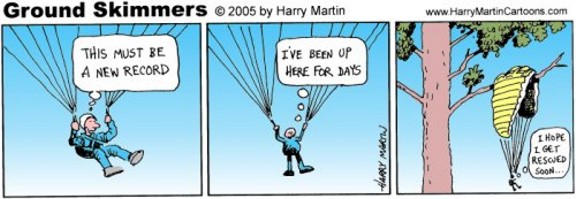
Or perhaps one of my favorite cartoons related to the matter... Thanks to Harry Martin who has some great Paragliding and Hang Gliding cartoons on his site.


This Page last updated 2 March 2012 Copyright TowMeUp.com All Rights Reserved